
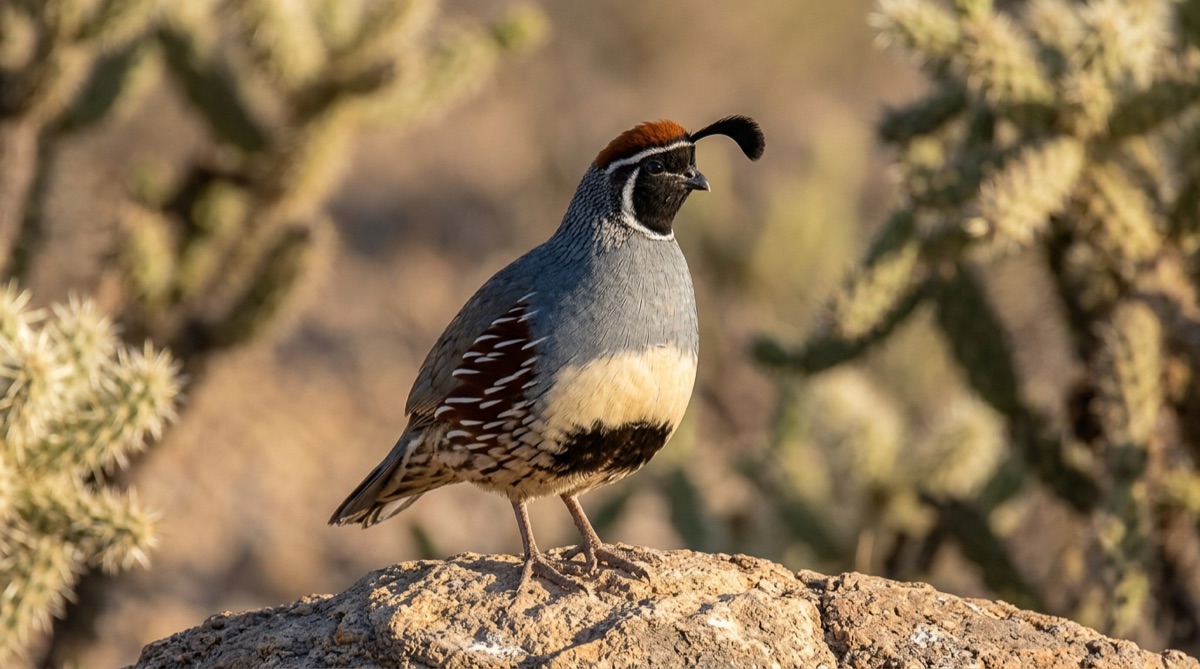
The birds · upland
Callipepla gambelii · desert quail, topknot
Gambel's Quail.
RUNS. THIS IS A FOOTRACE.
The dog read
RUNS. THIS IS A FOOTRACE.
Arizona's hunter-education material is blunt: Gambel's are more apt to run or flush than hold for a dog. Project Upland describes desert quail as having an incredible capacity to run, preferring to run from predators including hunters, so that the first sighting of a covey is often birds already running ahead through the brush. One source clocks the sprint at roughly 20 feet per second.
INEXPERIENCED DOGS CHASE, AND LOSE.
Project Upland notes directly that inexperienced dogs want to chase running birds. A dog that learns to swing wide and get ahead of a running covey is worth ten that follow it.
HUNT THE WATER.
Project Upland notes desert quail are usually found within a half mile of water, and that watering holes are obvious places to hunt. Water concentrates birds, and in this country it concentrates the dog's chances too.
HEAT IS THE LIMITING FACTOR, NOT THE BIRDS.
Dive Bomb advises conditioning dogs for hot dry weather and rough terrain, carrying water for handler and dog both, and watching for cactus injury and overheating during warm stretches. Birds feed early and late to stay out of the heat; hunt when they do.
RETRIEVE: SMALL BIRD, PUNISHING GROUND.
Downed birds land under cholla, prickly pear, and catclaw. Pointing Dog Journal warns rattlesnakes are out early in the season and to be especially aware when looking for downed birds.
Where and when
Sonoran Desert and chaparral, mesquite washes, prickly pear, brushy hillsides, desert riparian. Field & Stream notes an affinity for honey mesquite, and that birds roost off the ground in brush or trees, dropping down to feed early and late in coveys of a dozen or so. Coveys walk to water morning and evening. Range runs from southeastern California and southern Nevada across southern Arizona into New Mexico. Not a California quail: Gambel's has white stripes on chestnut-red flanks and a plain buff belly; California quail has a heavily scaled belly.
Hazards to the dog
- Cactus, cholla and prickly pear, the defining hazard; carry pliers
- Rattlesnakes, out early season, snake-avoidance training is standard practice here
- Heat and dehydration
- Loose rocky footing, one guide compares walking the desert to walking on marbles
- Javelina, which travel in family groups and can be aggressive if startled
Sources: Gambel's Quail (Arizona hunter education) · Gambel's Quail (Audubon / Tucson Bird Alliance) · Desert quail (Project Upland) · Desert quail coverage (Dive Bomb) · Desert hazards (Pointing Dog Journal) · Gambel's quail (Field & Stream). Reviewed by Chad McClellan. Where sources disagree the page says so; KENAI does not settle a contested read.
The gambel's quail guides.
Three KENAI guides for this bird: first season, second season, the advanced field guide. Give us an email and they open here; you get the Weekly Read with them. Unsubscribe any time.
No spam, ever. Weekly, and only when there is something worth reading.
This bird, in the field, with your dog.
Log a hunt on gambel's quail and the KENAI app opens this read beside your dog’s record, with the morning’s conditions and THE KENAI INDEX for the day. Free to start.
Get the app